AIMeetingPrep:BriefsfromCalendar,Email,CRM,andWebResearch
AI Meeting Prep: Briefs from Calendar, Email, CRM, and Web Research
The hardest part of meeting prep is not writing a summary. It is finding the right context in time.
A sales call may need the calendar invite, the original email thread, the CRM opportunity, the prospect's website, LinkedIn profiles, previous demos, support history, pricing context, and a relevant product workflow to show live. A recruiting call may need the resume, past interview notes, GitHub, LinkedIn, and the open role. A partnership call may need both companies' distribution, incentives, and next-step options.
Strawberry is useful because it can prepare from the same places a strong operator would check manually: your browser, calendar, inbox, CRM, files, and the public web.
What good AI meeting prep includes
A useful meeting brief should answer five questions:
- Who is in the meeting?
- Why are we meeting now?
- What do they likely care about?
- What should we show, ask, or decide?
- What follow-up should be ready before the meeting ends?
Generic summaries do not help much. The value comes from specific context and a clear meeting plan.
Meeting prep workflows Strawberry can run
Sales discovery prep
Strawberry can read the calendar invite, search the inbox for the thread, inspect CRM notes, research the company, and create a meeting plan with suggested discovery questions. It can also propose a live demo workflow that matches the prospect's business instead of showing a generic product tour.
For example, an agency prospect might get a demo around client reporting, journalist research, SEO monitoring, or Meta Ads analysis. A sales leader might get account research, outbound list generation, or CRM cleanup.
Customer onboarding prep
For onboarding calls, Strawberry can check who has joined the team, what plan they are on, what integrations are connected, where they got stuck, and which workflows are most likely to create a first win. The operator enters the meeting with a concrete path, not a blank "what do you want to automate?" question.
Partnership prep
For partner meetings, Strawberry can research the partner's audience, pricing model, distribution channels, credibility signals, and overlap with Strawberry's ICP. It can then draft a partnership agenda: who brings distribution, who brings product value, how attribution works, and what a low-risk pilot could look like.
Recruiting prep
For interviews, Strawberry can summarize the candidate's public profile, extract relevant work examples, compare the background against the role, and prepare structured questions. It can also create follow-up tasks after the call.
What makes browser-based prep different
Meeting prep often depends on logged-in context. A normal AI chatbot can summarize text you paste into it, but it usually cannot move across a calendar invite, Gmail thread, CRM opportunity, Google Doc, product admin page, and public website in one workflow.
A browser agent can.
That turns meeting prep from a one-off prompt into a repeatable operating system. The agent can prepare the brief, open the useful links, create a follow-up draft, and update the CRM after the call.
Suggested meeting brief format
A practical Strawberry meeting brief should include:
- meeting time, participants, and roles;
- relationship history and latest thread summary;
- company snapshot and trigger event;
- likely pain points;
- recommended demo workflow;
- discovery questions;
- objections to expect;
- next-step proposal;
- follow-up draft or task.
Implementation checklist
Start by defining what a finished brief should look like for each meeting type. Sales discovery, onboarding, recruiting, investor, partnership, and support escalation calls need different prep.
A practical setup is:
- connect calendar and email;
- connect the CRM or notes system;
- keep meeting transcripts in a searchable place;
- define the brief template for each meeting type;
- add a rule for pending RSVPs and missing meeting links;
- create a follow-up draft template that can be filled after the call.
For sales teams, the most important field is usually the recommended demo workflow. For founders and operators, it is often the decision or next action the meeting should produce. For recruiting, it is the gap between the candidate's evidence and the role requirements.
What to avoid
Do not prepare meetings like a Wikipedia page. A long company overview is less useful than a crisp agenda, three specific questions, and one tailored workflow to show.
Also avoid relying only on public web research. The best context is usually private: the latest email, the missed promise, the CRM note, the prior transcript, or the task that never got closed.
How to measure quality
Good meeting prep should improve the meeting, not just fill a document. Track whether the brief helped the operator ask sharper questions, show a more relevant workflow, avoid repeated context questions, and leave the call with a specific next step.
For recurring external meetings, keep a short feedback loop. After each call, ask what context was missing and add that source to the next brief. Over a few weeks, the prep template becomes a repeatable operating system for sales, partnerships, hiring, and customer success.
Starter prompt
Use this prompt inside Strawberry:
Prepare me for my next external meeting. Read the calendar invite, related Gmail threads, CRM notes, and the company's website. Give me a short brief with who is attending, why the meeting matters, what they likely care about, the best Strawberry workflow to demo, three discovery questions, and the best next-step CTA. If there are pending RSVPs or missing context, flag that first.
Related Strawberry workflows
Meeting prep becomes stronger when combined with AI for sales, AI for recruiting, AI for CRM hygiene, AI for research, and browser agents for sales teams.
Meeting prep context map
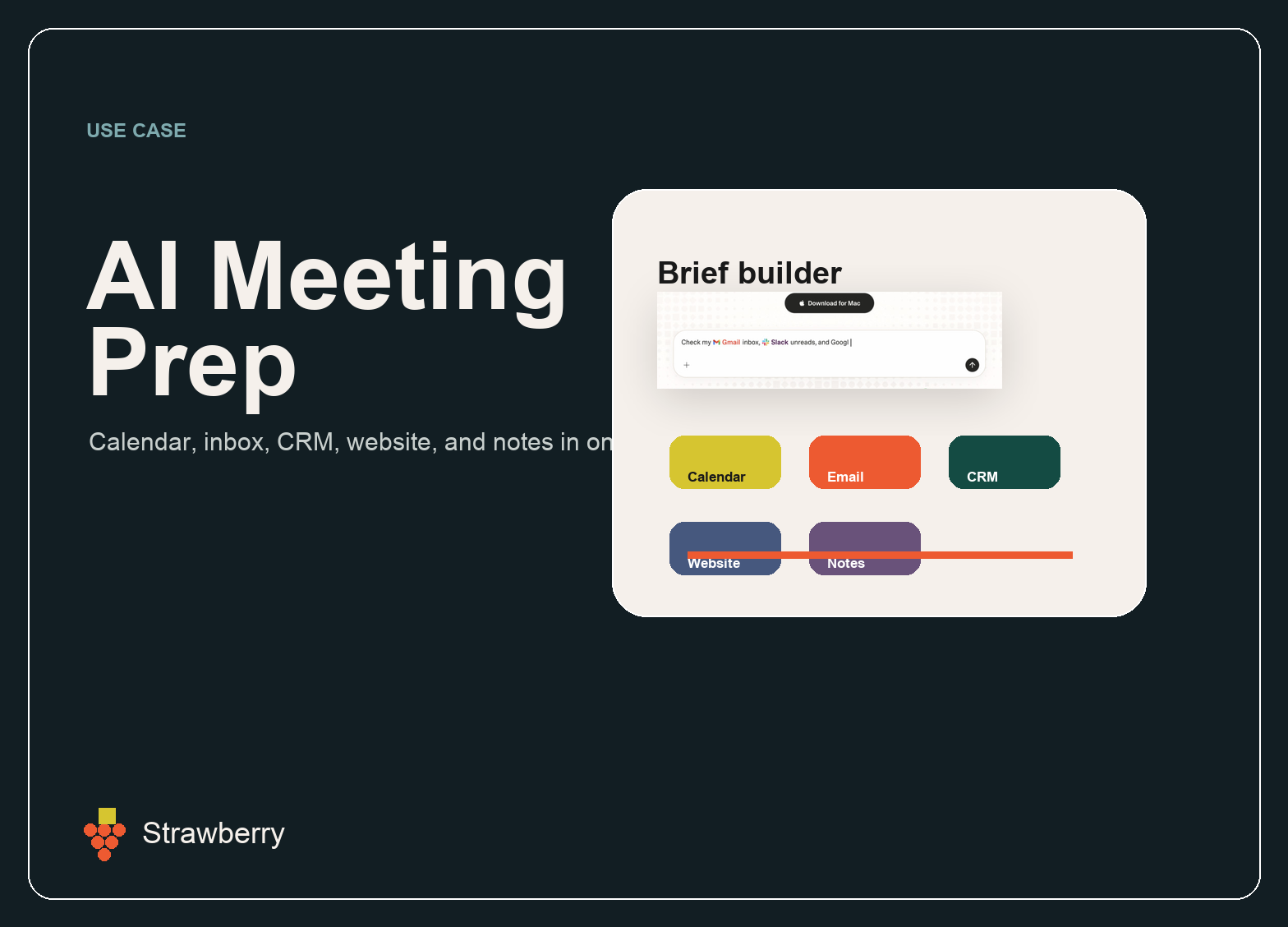
Calendar
Read attendees, meeting title, time, conferencing link, and RSVP status.
Inbox
Find the original thread, recent replies, promised next steps, and open questions.
CRM and notes
Pull opportunity stage, past calls, tasks, owners, and relationship context.
Web research
Research the company, trigger events, role context, and a tailored demo idea.
Prepare me for my next external meeting. Read the calendar invite, related Gmail threads, CRM notes, and the company's website. Give me a short brief with who is attending, why the meeting matters, what they likely care about, the best Strawberry workflow to demo, three discovery questions, and the best next-step CTA. If there are pending RSVPs or missing context, flag that first.
Yes. It can run on a schedule, but the safest workflow is to produce a brief and suggested next steps before the meeting rather than changing external systems without review.