Use Notion with an AI Browser for Content Planning
Run content planning in Strawberry using Notion as one of the inputs. Specific surfaces, example prompt, real output, and tradeoffs vs alternatives.
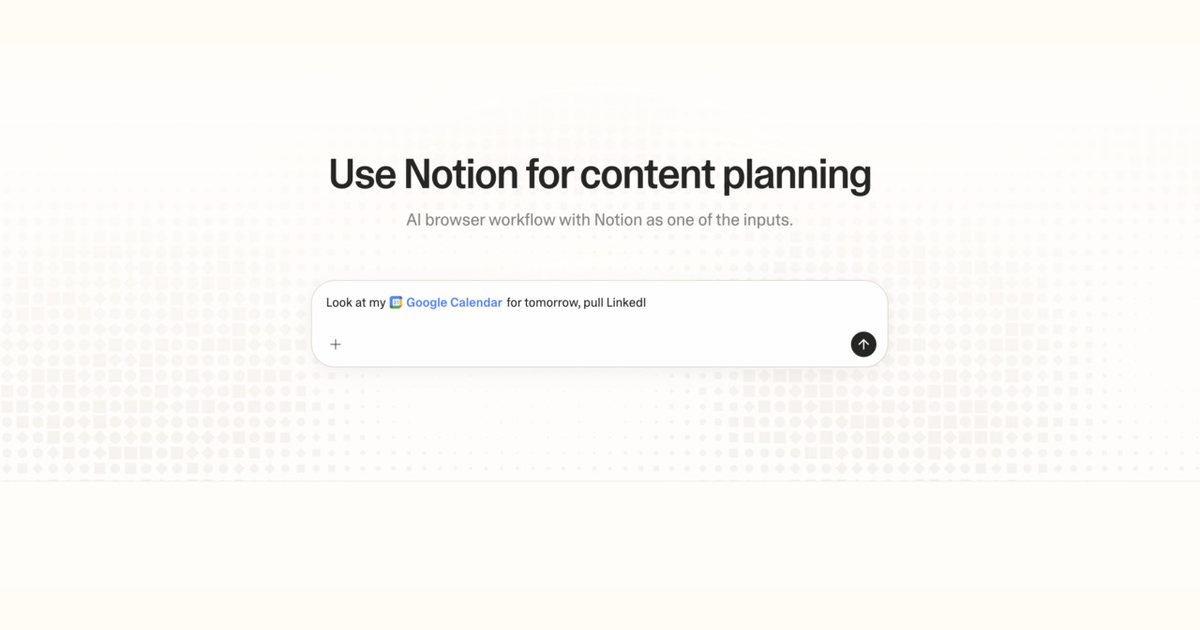
If you use Notion and you regularly need to plan the next content cycle, the bottleneck is usually the same: Notion holds part of the context, but content planning also needs signals that live outside it - on the public web, in LinkedIn, in news, in other connected apps. Strawberry is built to combine the Notion context with the rest of the browser, and run the full workflow as a companion you can re-trigger every week.
This page describes specifically how Strawberry handles content planning when Notion is one of the inputs. It names the Notion surfaces involved, the signals the workflow actually needs, an example prompt you can paste, and what a good output looks like.
The job a content marketer, founder writing for the company, brand lead is trying to do
The goal of content planning is to decide what to publish next week and why, with each piece tied to a specific search query or audience. The success metric is concrete: ratio of published-to-planned > 80%, average time-on-page above 2 minutes, organic traffic up week over week. That definition matters because it shapes what Notion needs to contribute to the workflow.
What signals content planning actually needs
For each signal below, here is whether Notion can contribute directly or whether Strawberry has to find it via the browser:
- Current search rankings and traffic - Notion does not contain this directly. Strawberry uses the browser plus public sources to fetch it.
- Competitor content gaps - Notion does not contain this directly. Strawberry uses the browser plus public sources to fetch it.
- Questions the sales team gets repeatedly - Notion does not contain this directly. Strawberry uses the browser plus public sources to fetch it.
- Internal subject-matter expertise - Notion does not contain this directly. Strawberry uses the browser plus public sources to fetch it.
- Seasonal or event-driven hooks - Notion does not contain this directly. Strawberry uses the browser plus public sources to fetch it.
- Internal data the team could publish - Notion does not contain this directly. Strawberry uses the browser plus public sources to fetch it.
What Strawberry can do inside Notion
Strawberry can query a Notion database, summarize a page, and append structured notes - ideal for research compendiums, project trackers, and team wikis.
Notion surfaces Strawberry uses for this workflow: pages, databases, blocks, filters, views.
How Strawberry runs content planning with Notion
- Strawberry opens the Notion pages that contains the relevant context.
- The companion pulls related context from Notion (databases, history, attached files) where it exists.
- For the parts Notion does not store, Strawberry uses the browser - web search, LinkedIn, news, the prospect's website.
- Strawberry synthesises the output in the shape this workflow needs: A content calendar with each row.
- A human reviews before any external action (send, update, post). Then the approved output is saved back to Notion or your system of record.
Example Strawberry prompt
Paste this in a new Strawberry chat with Notion connected. Adjust the specifics to your actual ICP, role, or topic.
Read this Notion pages and any linked context.
Then run a full content planning workflow on it. Use the browser to fill any gaps not in Notion.
Return the output in the shape we use for content planning: A content calendar with each row: target keyword/audience, format, hook, draft owner, due date.
Do not send anything externally. Save the draft to me to review.
What a good content planning output looks like
Here is what a finished output for content planning should look like in practice. The specifics will change for your use case, but the shape should look similar:
- Week 24 - Content plan
- Mon: comparison post 'Strawberry vs Manus' - target 'manus AI alternative' - draft by Laurits - publish Tue
- Wed: customer story Iltihouse - target 'AI for outbound sales' - draft by Lotte - publish Thu
- Fri: weekly product release recap - target loyal users + Github watchers - draft by Charles - publish Fri
Why Notion for this, and where to use a different tool
Notion is strong for this workflow because Strawberry can query a Notion database, summarize a page, and append structured notes - ideal for research compendiums, project trackers, and team wikis.
Where Notion falls short Notion's block-based API doesn't support all formatting; relations and rollups can be brittle through API.
Consider also the rest of your stack for the parts Notion doesn't cover.
Common mistakes when running content planning
- Planning content nobody actually searches for
- No internal owner so the calendar slips week after week
- Writing about generic topics where the team has no edge
Connecting Notion to Strawberry
Notion OAuth - workspace-scoped. Once connected, the companion can read the surfaces above without re-authenticating, and any write action still requires explicit human approval the first time the workflow runs.
Caveats
Do not let any AI agent send emails, update CRM records, or change shared systems without a clear approval step. Strawberry is strongest when the workflow combines browser context with connected-app context and a human review for sensitive actions.
How Notion + Strawberry runs content planning
Read
Open the relevant Notion pages; pull related context.
Augment
Use the browser, LinkedIn, news, and other connected apps for signals outside the CRM/tool.
Compose
Synthesise into the content planning shape: A content calendar with each row.
Approve
Human reviews before any external action; approved output is saved back.
FAQ - Notion + AI browser for content planning
Can Strawberry do content planning entirely inside Notion?
No, and that is the point. content planning needs signals Notion does not store - public web, LinkedIn, news, other apps. Strawberry combines Notion with the browser, which is where the real value comes from.
Does Notion need to be the primary CRM or system of record?
Not necessarily. Notion can be one input among several. Strawberry can read it as context even if your primary system of record is somewhere else.
What permissions do I need on Notion?
Read access to the surfaces you want Strawberry to use (pages, databases, blocks). Write permissions are only needed if you want Strawberry to update Notion after a human approves the change. Notion OAuth - workspace-scoped.
What is the realistic success metric for content planning?
ratio of published-to-planned > 80%, average time-on-page above 2 minutes, organic traffic up week over week - that is the target Strawberry helps you hit, not the only thing it measures.
What is the biggest mistake to avoid?
Planning content nobody actually searches for.