Use Linear with an AI Browser for Competitor Monitoring
Run competitor monitoring in Strawberry using Linear as one of the inputs. Specific surfaces, example prompt, real output, and tradeoffs vs alternatives.
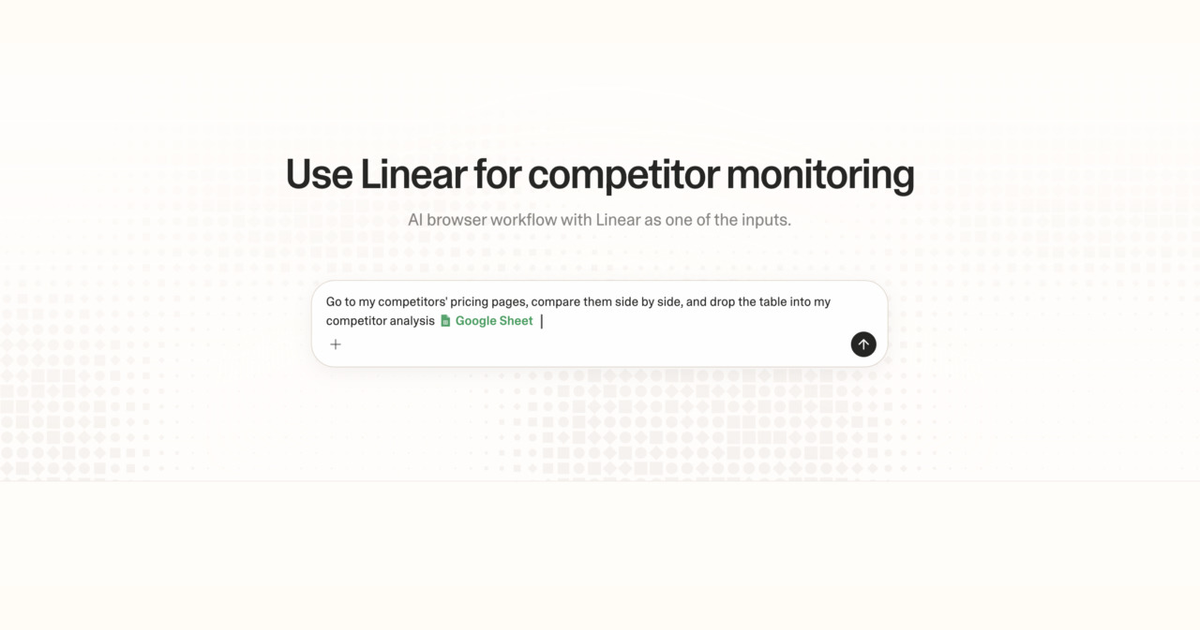
If you use Linear and you regularly need to monitor competitors, the bottleneck is usually the same: Linear holds part of the context, but competitor monitoring also needs signals that live outside it - on the public web, in LinkedIn, in news, in other connected apps. Strawberry is built to combine the Linear context with the rest of the browser, and run the full workflow as a companion you can re-trigger every week.
This page describes specifically how Strawberry handles competitor monitoring when Linear is one of the inputs. It names the Linear surfaces involved, the signals the workflow actually needs, an example prompt you can paste, and what a good output looks like.
The job a product marketer, founder, sales enablement lead is trying to do
The goal of competitor monitoring is to stay current on what competitors are launching, hiring, and saying so the team can react fast. The success metric is concrete: sales team correctly handles competitor objections without escalating to product marketing. That definition matters because it shapes what Linear needs to contribute to the workflow.
What signals competitor monitoring actually needs
For each signal below, here is whether Linear can contribute directly or whether Strawberry has to find it via the browser:
- Competitor pricing page changes - Linear does not contain this directly. Strawberry uses the browser plus public sources to fetch it.
- New product launches and changelogs - Linear does not contain this directly. Strawberry uses the browser plus public sources to fetch it.
- Key hires (especially GTM leadership) - Linear does not contain this directly. Strawberry uses the browser plus public sources to fetch it.
- Funding events - Linear does not contain this directly. Strawberry uses the browser plus public sources to fetch it.
- Comparison content where the competitor is mentioned - Linear does not contain this directly. Strawberry uses the browser plus public sources to fetch it.
- Review platform sentiment shifts (G2, Capterra) - Linear does not contain this directly. Strawberry uses the browser plus public sources to fetch it.
What Strawberry can do inside Linear
Strawberry can read recent issues, create new tickets from external sources, and link related issues.
Linear surfaces Strawberry uses for this workflow: issues, projects, cycles, labels, states.
How Strawberry runs competitor monitoring with Linear
- Strawberry opens the Linear issues that contains the relevant context.
- The companion pulls related context from Linear (projects, history, attached files) where it exists.
- For the parts Linear does not store, Strawberry uses the browser - web search, LinkedIn, news, the prospect's website.
- Strawberry synthesises the output in the shape this workflow needs: A weekly digest grouped by competitor.
- A human reviews before any external action (send, update, post). Then the approved output is saved back to Linear or your system of record.
Example Strawberry prompt
Paste this in a new Strawberry chat with Linear connected. Adjust the specifics to your actual ICP, role, or topic.
Read this Linear issues and any linked context.
Then run a full competitor monitoring workflow on it. Use the browser to fill any gaps not in Linear.
Return the output in the shape we use for competitor monitoring: A weekly digest grouped by competitor: what changed, why it matters, what to do.
Do not send anything externally. Save the draft to me to review.
What a good competitor monitoring output looks like
Here is what a finished output for competitor monitoring should look like in practice. The specifics will change for your use case, but the shape should look similar:
- Week of June 2 - Competitor X
- What changed: pricing page added a 'Team' tier at $99/seat, removed the per-user-cap on Pro
- Why it matters: directly hits our Pro positioning; lowers their effective entry price by 30%
- What to do: update battlecard, draft new objection answer for AEs by Friday
Why Linear for this, and where to use a different tool
Linear is strong for this workflow because Strawberry can read recent issues, create new tickets from external sources, and link related issues.
Where Linear falls short Linear permissions are team-scoped; bulk create requires GraphQL mutations.
Consider also a CRM for go-to-market follow-up.
Common mistakes when running competitor monitoring
- Summarising press releases without 'so what'
- Missing the changelog because it's not in marketing channels
- Spending an hour on a competitor that doesn't actually win deals
Connecting Linear to Strawberry
Linear OAuth. Once connected, the companion can read the surfaces above without re-authenticating, and any write action still requires explicit human approval the first time the workflow runs.
Caveats
Do not let any AI agent send emails, update CRM records, or change shared systems without a clear approval step. Strawberry is strongest when the workflow combines browser context with connected-app context and a human review for sensitive actions.
How Linear + Strawberry runs competitor monitoring
Read
Open the relevant Linear issues; pull related context.
Augment
Use the browser, LinkedIn, news, and other connected apps for signals outside the CRM/tool.
Compose
Synthesise into the competitor monitoring shape: A weekly digest grouped by competitor.
Approve
Human reviews before any external action; approved output is saved back.
FAQ - Linear + AI browser for competitor monitoring
Can Strawberry do competitor monitoring entirely inside Linear?
No, and that is the point. competitor monitoring needs signals Linear does not store - public web, LinkedIn, news, other apps. Strawberry combines Linear with the browser, which is where the real value comes from.
Does Linear need to be the primary CRM or system of record?
Not necessarily. Linear can be one input among several. Strawberry can read it as context even if your primary system of record is somewhere else.
What permissions do I need on Linear?
Read access to the surfaces you want Strawberry to use (issues, projects, cycles). Write permissions are only needed if you want Strawberry to update Linear after a human approves the change. Linear OAuth.
What is the realistic success metric for competitor monitoring?
sales team correctly handles competitor objections without escalating to product marketing - that is the target Strawberry helps you hit, not the only thing it measures.
What is the biggest mistake to avoid?
Summarising press releases without 'so what'.