Use Calendly with an AI Browser for Prospect Research
Run prospect research in Strawberry using Calendly as one of the inputs. Specific surfaces, example prompt, real output, and tradeoffs vs alternatives.
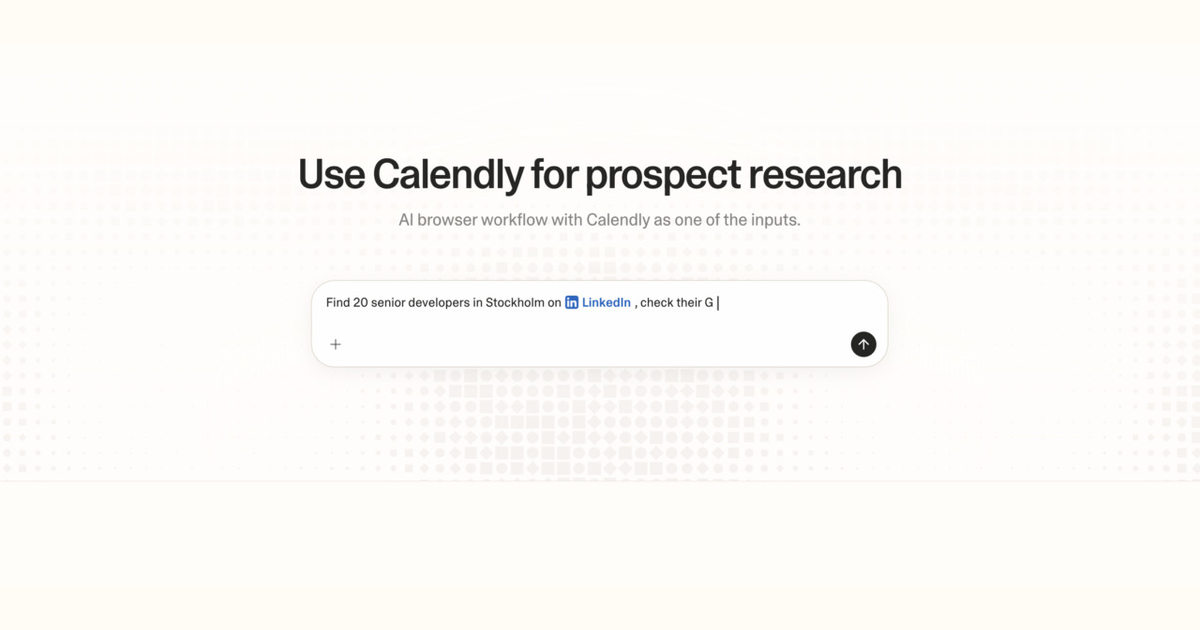
If you use Calendly and you regularly need to research a prospect, the bottleneck is usually the same: Calendly holds part of the context, but prospect research also needs signals that live outside it - on the public web, in LinkedIn, in news, in other connected apps. Strawberry is built to combine the Calendly context with the rest of the browser, and run the full workflow as a companion you can re-trigger every week.
This page describes specifically how Strawberry handles prospect research when Calendly is one of the inputs. It names the Calendly surfaces involved, the signals the workflow actually needs, an example prompt you can paste, and what a good output looks like.
The job a sales rep, founder, or account executive is trying to do
The goal of prospect research is to decide whether a prospect is worth a calendar slot and prepare a personalised first touch. The success metric is concrete: first reply rate above 8% and a meeting booked in under 14 days from first touch. That definition matters because it shapes what Calendly needs to contribute to the workflow.
What signals prospect research actually needs
For each signal below, here is whether Calendly can contribute directly or whether Strawberry has to find it via the browser:
- Role tenure and seniority on LinkedIn - Calendly does not contain this directly. Strawberry uses the browser plus public sources to fetch it.
- Recent funding rounds or M&A activity - Calendly does not contain this directly. Strawberry uses the browser plus public sources to fetch it.
- Headcount growth or layoffs in the last 6 months - Calendly does not contain this directly. Strawberry uses the browser plus public sources to fetch it.
- Tech stack and procurement signals - Calendly does not contain this directly. Strawberry uses the browser plus public sources to fetch it.
- Recent content the prospect has published or commented on - Calendly does not contain this directly. Strawberry uses the browser plus public sources to fetch it.
- Open job postings that reveal team priorities - Calendly does not contain this directly. Strawberry uses the browser plus public sources to fetch it.
What Strawberry can do inside Calendly
Strawberry can list upcoming bookings and prepare invitee-specific briefs.
Calendly surfaces Strawberry uses for this workflow: event types, scheduled events, invitees, team availability.
How Strawberry runs prospect research with Calendly
- Strawberry opens the Calendly event types that contains the relevant context.
- The companion pulls related context from Calendly (scheduled events, history, attached files) where it exists.
- For the parts Calendly does not store, Strawberry uses the browser - web search, LinkedIn, news, the prospect's website.
- Strawberry synthesises the output in the shape this workflow needs: A one-page brief.
- A human reviews before any external action (send, update, post). Then the approved output is saved back to Calendly or your system of record.
Example Strawberry prompt
Paste this in a new Strawberry chat with Calendly connected. Adjust the specifics to your actual ICP, role, or topic.
Read this Calendly event types and any linked context.
Then run a full prospect research workflow on it. Use the browser to fill any gaps not in Calendly.
Return the output in the shape we use for prospect research: A one-page brief: name, role, company, ICP fit (yes/no with reason), top 3 talking points, suggested first message, 1-2 source links.
Do not send anything externally. Save the draft to me to review.
What a good prospect research output looks like
Here is what a finished output for prospect research should look like in practice. The specifics will change for your use case, but the shape should look similar:
- Anna Lindqvist - VP Marketing, Voi Technology
- ICP fit: yes (Series D scooter co, EU expansion, 1500 employees)
- Talking point 1: hired 4 paid-acquisition managers in last 90 days - clear shift toward performance marketing
- Talking point 2: spoke at SuperVenture last month on scooter unit economics
- Talking point 3: company just announced Germany pull-out - retention focus is likely a priority
- Suggested first message: short, references the SuperVenture talk, asks one specific question, no calendar link
Why Calendly for this, and where to use a different tool
Calendly is strong for this workflow because Strawberry can list upcoming bookings and prepare invitee-specific briefs.
Where Calendly falls short Calendly does not expose detailed account context - it's a routing layer, not a CRM.
Consider also a CRM for the relationship layer.
Common mistakes when running prospect research
- Researching prospects who don't match ICP - the brief is wasted
- Generic talking points ("impressive growth") that don't reference any real signal
- Copying public bio text instead of synthesising fit
Connecting Calendly to Strawberry
Calendly OAuth. Once connected, the companion can read the surfaces above without re-authenticating, and any write action still requires explicit human approval the first time the workflow runs.
Caveats
Do not let any AI agent send emails, update CRM records, or change shared systems without a clear approval step. Strawberry is strongest when the workflow combines browser context with connected-app context and a human review for sensitive actions.
How Calendly + Strawberry runs prospect research
Read
Open the relevant Calendly event types; pull related context.
Augment
Use the browser, LinkedIn, news, and other connected apps for signals outside the CRM/tool.
Compose
Synthesise into the prospect research shape: A one-page brief.
Approve
Human reviews before any external action; approved output is saved back.
FAQ - Calendly + AI browser for prospect research
Can Strawberry do prospect research entirely inside Calendly?
No, and that is the point. prospect research needs signals Calendly does not store - public web, LinkedIn, news, other apps. Strawberry combines Calendly with the browser, which is where the real value comes from.
Does Calendly need to be the primary CRM or system of record?
Not necessarily. Calendly can be one input among several. Strawberry can read it as context even if your primary system of record is somewhere else.
What permissions do I need on Calendly?
Read access to the surfaces you want Strawberry to use (event types, scheduled events, invitees). Write permissions are only needed if you want Strawberry to update Calendly after a human approves the change. Calendly OAuth.
What is the realistic success metric for prospect research?
first reply rate above 8% and a meeting booked in under 14 days from first touch - that is the target Strawberry helps you hit, not the only thing it measures.
What is the biggest mistake to avoid?
Researching prospects who don't match ICP - the brief is wasted.