Use Calendly with an AI Browser for Candidate Sourcing
Run candidate sourcing in Strawberry using Calendly as one of the inputs. Specific surfaces, example prompt, real output, and tradeoffs vs alternatives.
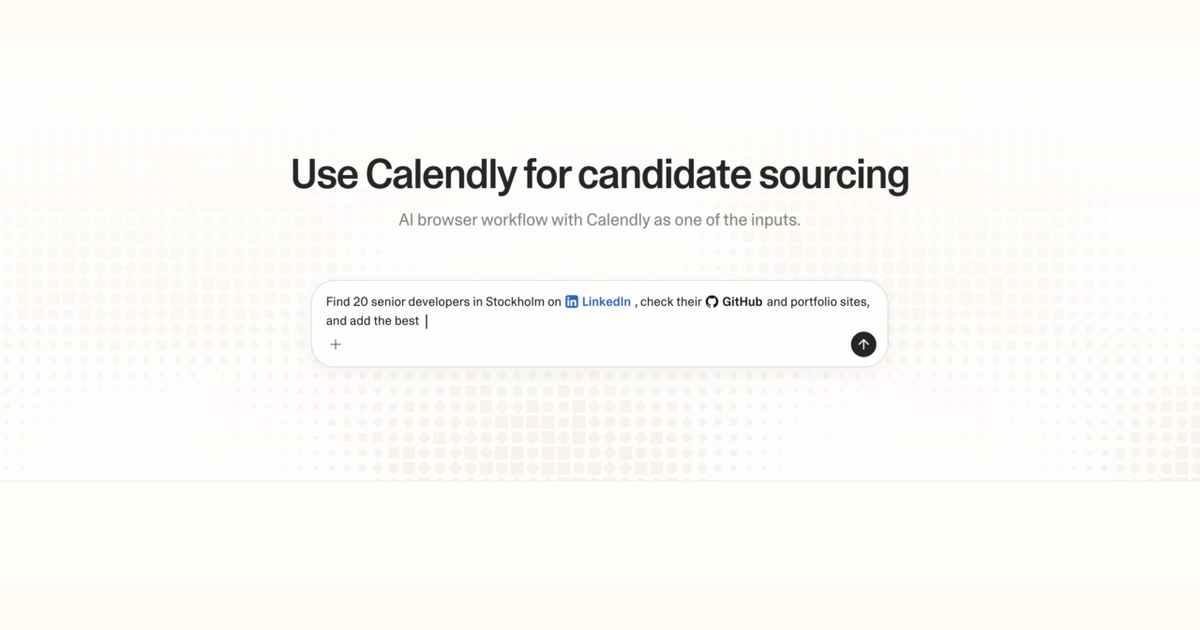
If you use Calendly and you regularly need to source candidates, the bottleneck is usually the same: Calendly holds part of the context, but candidate sourcing also needs signals that live outside it - on the public web, in LinkedIn, in news, in other connected apps. Strawberry is built to combine the Calendly context with the rest of the browser, and run the full workflow as a companion you can re-trigger every week.
This page describes specifically how Strawberry handles candidate sourcing when Calendly is one of the inputs. It names the Calendly surfaces involved, the signals the workflow actually needs, an example prompt you can paste, and what a good output looks like.
The job a recruiter, founder hiring, hiring manager is trying to do
The goal of candidate sourcing is to build a shortlist of 10-30 candidates who match the role and have at least one signal of openness. The success metric is concrete: 30% reply rate to first outreach, 5+ first-call conversions per 30 sourced. That definition matters because it shapes what Calendly needs to contribute to the workflow.
What signals candidate sourcing actually needs
For each signal below, here is whether Calendly can contribute directly or whether Strawberry has to find it via the browser:
- Current role and tenure - Calendly does not contain this directly. Strawberry uses the browser plus public sources to fetch it.
- Recent role changes (often visible on LinkedIn) - Calendly does not contain this directly. Strawberry uses the browser plus public sources to fetch it.
- GitHub or content output for technical roles - Calendly does not contain this directly. Strawberry uses the browser plus public sources to fetch it.
- Company stage match (someone leaving a Series B is more likely to talk to a seed-stage co) - Calendly does not contain this directly. Strawberry uses the browser plus public sources to fetch it.
- Geo match for hybrid roles - Calendly does not contain this directly. Strawberry uses the browser plus public sources to fetch it.
- Openness signals (LinkedIn open-to-work, recent comments about job search) - Calendly does not contain this directly. Strawberry uses the browser plus public sources to fetch it.
What Strawberry can do inside Calendly
Strawberry can list upcoming bookings and prepare invitee-specific briefs.
Calendly surfaces Strawberry uses for this workflow: event types, scheduled events, invitees, team availability.
How Strawberry runs candidate sourcing with Calendly
- Strawberry opens the Calendly event types that contains the relevant context.
- The companion pulls related context from Calendly (scheduled events, history, attached files) where it exists.
- For the parts Calendly does not store, Strawberry uses the browser - web search, LinkedIn, news, the prospect's website.
- Strawberry synthesises the output in the shape this workflow needs: A shortlist with one row per candidate.
- A human reviews before any external action (send, update, post). Then the approved output is saved back to Calendly or your system of record.
Example Strawberry prompt
Paste this in a new Strawberry chat with Calendly connected. Adjust the specifics to your actual ICP, role, or topic.
Read this Calendly event types and any linked context.
Then run a full candidate sourcing workflow on it. Use the browser to fill any gaps not in Calendly.
Return the output in the shape we use for candidate sourcing: A shortlist with one row per candidate: name, current role, target role fit (1-5), one personalised opening line, contact link.
Do not send anything externally. Save the draft to me to review.
What a good candidate sourcing output looks like
Here is what a finished output for candidate sourcing should look like in practice. The specifics will change for your use case, but the shape should look similar:
- Role: Founding Engineer (Stockholm or remote EU)
- Candidate: Marek Novak - Senior Engineer @ Klarna, 4 years
- Fit: 5/5 (worked on payment systems, contributed to Rust open source, recent talk on type-safe APIs)
- Opening line: noticed his RustConf talk on type-safe API contracts and our backend lead's tweet about Marek's library
- Contact: LinkedIn DM + GitHub email
Why Calendly for this, and where to use a different tool
Calendly is strong for this workflow because Strawberry can list upcoming bookings and prepare invitee-specific briefs.
Where Calendly falls short Calendly does not expose detailed account context - it's a routing layer, not a CRM.
Consider also a CRM for the relationship layer.
Common mistakes when running candidate sourcing
- Spray-and-pray DMs that mention nothing specific
- Missing the obvious signals (someone just posted 'thinking about a change')
- No quality bar - putting 200 names on the list to look productive
Connecting Calendly to Strawberry
Calendly OAuth. Once connected, the companion can read the surfaces above without re-authenticating, and any write action still requires explicit human approval the first time the workflow runs.
Caveats
Do not let any AI agent send emails, update CRM records, or change shared systems without a clear approval step. Strawberry is strongest when the workflow combines browser context with connected-app context and a human review for sensitive actions.
How Calendly + Strawberry runs candidate sourcing
Read
Open the relevant Calendly event types; pull related context.
Augment
Use the browser, LinkedIn, news, and other connected apps for signals outside the CRM/tool.
Compose
Synthesise into the candidate sourcing shape: A shortlist with one row per candidate.
Approve
Human reviews before any external action; approved output is saved back.
FAQ - Calendly + AI browser for candidate sourcing
Can Strawberry do candidate sourcing entirely inside Calendly?
No, and that is the point. candidate sourcing needs signals Calendly does not store - public web, LinkedIn, news, other apps. Strawberry combines Calendly with the browser, which is where the real value comes from.
Does Calendly need to be the primary CRM or system of record?
Not necessarily. Calendly can be one input among several. Strawberry can read it as context even if your primary system of record is somewhere else.
What permissions do I need on Calendly?
Read access to the surfaces you want Strawberry to use (event types, scheduled events, invitees). Write permissions are only needed if you want Strawberry to update Calendly after a human approves the change. Calendly OAuth.
What is the realistic success metric for candidate sourcing?
30% reply rate to first outreach, 5+ first-call conversions per 30 sourced - that is the target Strawberry helps you hit, not the only thing it measures.
What is the biggest mistake to avoid?
Spray-and-pray DMs that mention nothing specific.