Use Asana with an AI Browser for Data Extraction
Run data extraction in Strawberry using Asana as one of the inputs. Specific surfaces, example prompt, real output, and tradeoffs vs alternatives.
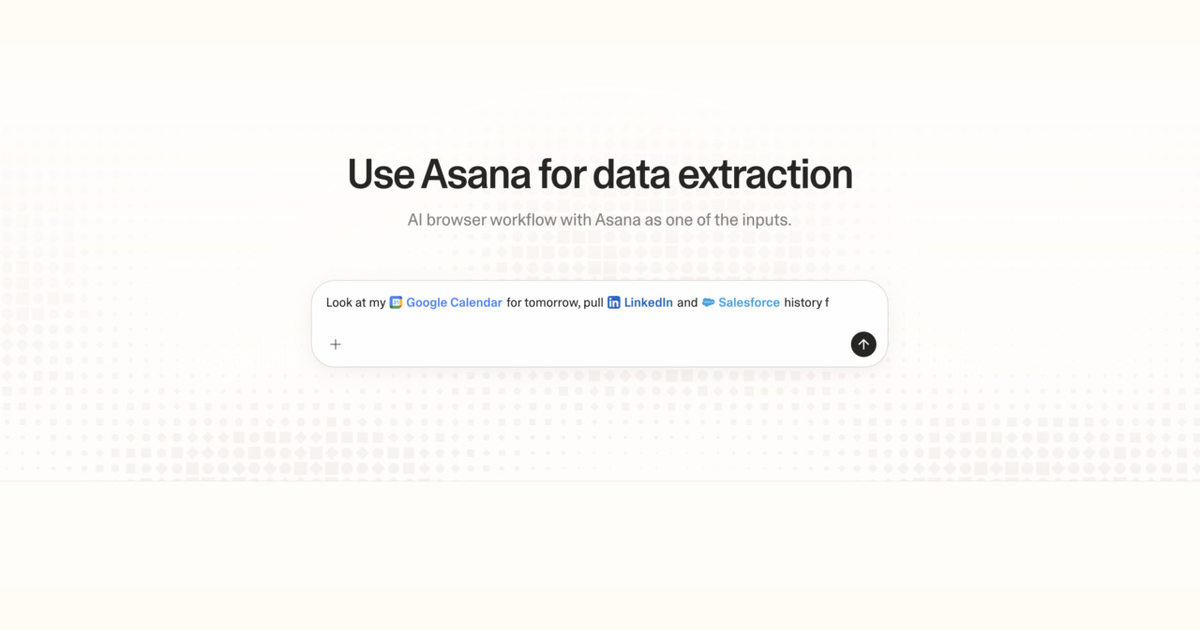
If you use Asana and you regularly need to extract structured data from websites, the bottleneck is usually the same: Asana holds part of the context, but data extraction also needs signals that live outside it - on the public web, in LinkedIn, in news, in other connected apps. Strawberry is built to combine the Asana context with the rest of the browser, and run the full workflow as a companion you can re-trigger every week.
This page describes specifically how Strawberry handles data extraction when Asana is one of the inputs. It names the Asana surfaces involved, the signals the workflow actually needs, an example prompt you can paste, and what a good output looks like.
The job a researcher, ops manager, analyst, founder doing market analysis is trying to do
The goal of data extraction is to turn unstructured pages into a clean table or dataset. The success metric is concrete: extraction accuracy above 95% on spot-checked rows, dedup rate above 95%, completeness above 90%. That definition matters because it shapes what Asana needs to contribute to the workflow.
What signals data extraction actually needs
For each signal below, here is whether Asana can contribute directly or whether Strawberry has to find it via the browser:
- Source URL pattern (one page, paginated, search results) - Asana does not contain this directly. Strawberry uses the browser plus public sources to fetch it.
- Target schema (which fields per row) - Asana does not contain this directly. Strawberry uses the browser plus public sources to fetch it.
- Completion criteria (how many rows expected) - Asana does not contain this directly. Strawberry uses the browser plus public sources to fetch it.
- Validation rules (which fields must be present) - Asana does not contain this directly. Strawberry uses the browser plus public sources to fetch it.
- Login or paywall barriers - Asana does not contain this directly. Strawberry uses the browser plus public sources to fetch it.
- Rate-limit posture of the target site - Asana does not contain this directly. Strawberry uses the browser plus public sources to fetch it.
What Strawberry can do inside Asana
Strawberry can create or update tasks based on meeting notes, research findings, or pipeline signals.
Asana surfaces Strawberry uses for this workflow: projects, tasks, subtasks, sections, milestones.
How Strawberry runs data extraction with Asana
- Strawberry opens the Asana projects that contains the relevant context.
- The companion pulls related context from Asana (tasks, history, attached files) where it exists.
- For the parts Asana does not store, Strawberry uses the browser - web search, LinkedIn, news, the prospect's website.
- Strawberry synthesises the output in the shape this workflow needs: A CSV or sheet with one row per extracted entity and a confidence column.
- A human reviews before any external action (send, update, post). Then the approved output is saved back to Asana or your system of record.
Example Strawberry prompt
Paste this in a new Strawberry chat with Asana connected. Adjust the specifics to your actual ICP, role, or topic.
Read this Asana projects and any linked context.
Then run a full data extraction workflow on it. Use the browser to fill any gaps not in Asana.
Return the output in the shape we use for data extraction: A CSV or sheet with one row per extracted entity and a confidence column.
Do not send anything externally. Save the draft to me to review.
What a good data extraction output looks like
Here is what a finished output for data extraction should look like in practice. The specifics will change for your use case, but the shape should look similar:
- Source: company directory at example.com/companies, 30 pages of 50 companies each
- Target schema: name, website, employee count, HQ city, sector tag
- Expected rows: ~1500 (50 x 30)
- Validation: name + website required; sector tag from a fixed list
- Output: ./companies.csv with 1485 rows after dedup, 12 rows flagged for human review
Why Asana for this, and where to use a different tool
Asana is strong for this workflow because Strawberry can create or update tasks based on meeting notes, research findings, or pipeline signals.
Where Asana falls short Custom fields vary by workspace; bulk operations need pagination.
Consider also a CRM for sales context.
Common mistakes when running data extraction
- No schema defined upfront, leading to inconsistent rows
- Ignoring pagination and missing 80% of the data
- Extracting from logged-in pages without confirming the cookies are valid
- Hammering the target site without rate-limiting
Connecting Asana to Strawberry
Asana OAuth - workspace-scoped. Once connected, the companion can read the surfaces above without re-authenticating, and any write action still requires explicit human approval the first time the workflow runs.
Caveats
Do not let any AI agent send emails, update CRM records, or change shared systems without a clear approval step. Strawberry is strongest when the workflow combines browser context with connected-app context and a human review for sensitive actions.
How Asana + Strawberry runs data extraction
Read
Open the relevant Asana projects; pull related context.
Augment
Use the browser, LinkedIn, news, and other connected apps for signals outside the CRM/tool.
Compose
Synthesise into the data extraction shape: A CSV or sheet with one row per extracted entity and a confidence column.
Approve
Human reviews before any external action; approved output is saved back.
FAQ - Asana + AI browser for data extraction
Can Strawberry do data extraction entirely inside Asana?
No, and that is the point. data extraction needs signals Asana does not store - public web, LinkedIn, news, other apps. Strawberry combines Asana with the browser, which is where the real value comes from.
Does Asana need to be the primary CRM or system of record?
Not necessarily. Asana can be one input among several. Strawberry can read it as context even if your primary system of record is somewhere else.
What permissions do I need on Asana?
Read access to the surfaces you want Strawberry to use (projects, tasks, subtasks). Write permissions are only needed if you want Strawberry to update Asana after a human approves the change. Asana OAuth - workspace-scoped.
What is the realistic success metric for data extraction?
extraction accuracy above 95% on spot-checked rows, dedup rate above 95%, completeness above 90% - that is the target Strawberry helps you hit, not the only thing it measures.
What is the biggest mistake to avoid?
No schema defined upfront, leading to inconsistent rows.