Strawberry vs Zapier for Client Reporting
Strawberry and Zapier for client reporting: where each wins, what the output actually looks like, paste-ready prompts, and pricing in context.
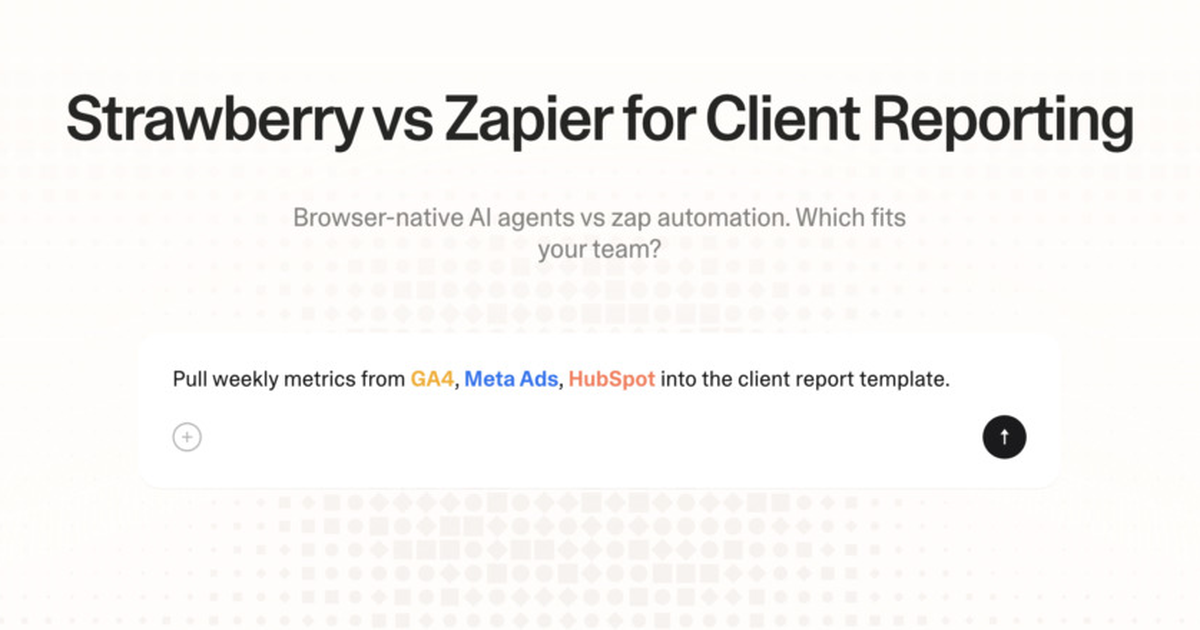
Zapier and Strawberry both show up when teams shop for help with client reporting. They do not solve the same problem. Zapier is a Workflow automation; Strawberry is an AI browser that lives in your real browser tabs and connected apps. This page is the head-to-head on client reporting specifically - where each one wins, what the output actually looks like, and the price you pay either way.
The short answer
For client reporting, pick Strawberry when the work needs to read logged-in pages and act across multiple apps in your real browser. Pick Zapier when you have a clean event (new lead, form submission, calendar event) and want a deterministic, no-thinking chain of API calls. If your workflow looks like "open three tabs, judge what matters, write something back into a CRM", Strawberry will close it faster. If it looks like "answer this clean question", Zapier is the cheaper tool.
What client reporting actually requires
The job is to produce a clean, on-brand recap of what was done, what worked, and what is next for a client. Success is measured as: report turnaround under 1 day, client approval without major revision. To do it well, the workflow needs these signals: campaign or activity data from connected ad/analytics tools; agreed KPIs and last-period comparison; qualitative wins or losses; next-period plan. Most of those signals live behind logins or scattered across the open web - which is exactly where the tool choice starts to matter.
How Strawberry handles client reporting
Strawberry runs inside your real browser. It reads the tabs you have open, pulls context from your connected apps (CRM, email, sheets, Slack, Notion, calendar), researches missing signals via the open web, and synthesises a draft in the shape your team uses. A human reviews before any external write. Because the agent sees the same pages you do, you can ask follow-up questions referencing what's on screen and get answers grounded in that context.
Concrete workflow with Strawberry
- Open the client's dashboards (GA4, Search Console, ads, CRM).
- Ask Strawberry to pull the period-over-period metrics that matter to this client.
- Have it write the narrative: what moved, why, and what to do next.
- Include 2-3 charts and 1-2 source links so the client can verify.
- Review the draft once, then send. Save the report to the shared drive.
Use this exact prompt in Strawberry to start the workflow:
I have [tab/app] open. Help me produce a client report for [name/company]. Read what's on screen plus any connected CRM and email context. Return: A PDF or Google Doc structured by section: summary, KPI table, highlights, plan, asks. Anchor every claim to a real signal from campaign or activity data from connected ad/analytics tools or agreed KPIs and last-period comparison. Do not invent facts. Stop before any external action - I'll review.
How Zapier handles client reporting
Zapier's strength is trigger-based zaps that connect 6000+ apps via official APIs. For client reporting, that pays off when the inputs are already clean and the output is text - drafting messages, summarising notes, answering questions about pasted material. Where it slows down is exactly what client reporting demands at scale: Zapier needs a clean API endpoint and a fixed trigger. Teams using Zapier for this end up copy-pasting screenshots, re-typing CRM fields, and switching context every few minutes.
Honest tradeoffs
Pick Strawberry when the work involves reading a webpage, scrolling LinkedIn, opening multiple tabs, or judging which option to take.
Pick Zapier when you have a clean event (new lead, form submission, calendar event) and want a deterministic, no-thinking chain of API calls.
Use them together when Zapier owns the drafting step and Strawberry owns the browser-side gathering and CRM write-back. Many teams keep both in their stack.
What a real client reporting output looks like
Specific, not generic:
- Client: Sparbanken Skåne - May 2026
- KPIs: CPC -12%, CTR +0.4pt, total leads +18%
- Highlights: new creative angle on retention won 60% of impressions
- Plan for June: scale the winning creative, test a second segment
- Asks: confirm copy review SLA for new creative
Strawberry produces this by reading the relevant tabs and apps, then drafting. Zapier produces this only if the inputs are already pasted into the chat.
Pricing in context
Zapier: free tier; paid plans from $20-100+/mo per user. Strawberry: free tier, Intern $20/mo, Part-Time $100/mo, Full-Time $250/mo, with team plans available. The honest comparison is hours of work saved per seat per week against list price, not list price alone. Teams that lean on client reporting weekly usually hit payback in the first month on either tool.
Three mistakes to avoid in client reporting
These bite regardless of which tool you pick:
- Report is mostly screenshots of dashboards with no synthesis
- Missing the comparison vs last period so the client can't tell if things are working
- No 'what we're doing about it' section for bad KPI movements
Caveats
Strawberry holds back on sending email, updating CRM records, or changing shared systems until a human approves the action. Treat the agent as a fast first-draft author, not an autopilot.
Strawberry vs Zapier for client reporting
Strawberry
Real browser + connected apps + judgment. Wins when the work involves reading a webpage, scrolling LinkedIn, opening multiple tabs, or judging which option to take.
Zapier
Trigger-based zaps that connect 6000+ apps via official APIs. Wins when you have a clean event (new lead, form submission, calendar event) and want a deterministic, no-thinking chain of API calls.
FAQ
Can I use Strawberry and Zapier together?
Yes - many teams do. Zapier handles drafting and Q&A on clean inputs; Strawberry handles the browser-side gathering and write-back into apps.
Which one is cheaper for client reporting?
Per seat, Strawberry typically lands between Zapier's free and mid tiers. The right comparison is time saved per seat per week, not list price.
Will Strawberry send emails or update CRM without me?
No. Strawberry stops before external writes and asks for review. You stay in the loop on the irreversible step.
What's the biggest mistake to avoid in client reporting?
Report is mostly screenshots of dashboards with no synthesis.