Strawberry vs Make for Meeting Prep
Strawberry and Make for meeting prep: where each wins, what the output actually looks like, paste-ready prompts, and pricing in context.
Make and Strawberry both show up when teams shop for help with meeting prep. They do not solve the same problem. Make is a Workflow automation; Strawberry is an AI browser that lives in your real browser tabs and connected apps. This page is the head-to-head on meeting prep specifically - where each one wins, what the output actually looks like, and the price you pay either way.
The short answer
For meeting prep, pick Strawberry when the work needs to read logged-in pages and act across multiple apps in your real browser. Pick Make when the workflow is a well-defined data pipeline with clean inputs and a fixed output schema. If your workflow looks like "open three tabs, judge what matters, write something back into a CRM", Strawberry will close it faster. If it looks like "answer this clean question", Make is the cheaper tool.
What meeting prep actually requires
The job is to produce a one-page brief for each upcoming meeting so the person walks in informed and time isn't wasted. Success is measured as: subjective - the meeting feels productive; objective - notes/next-step ratio is high. To do it well, the workflow needs these signals: attendee LinkedIn snapshots (role, tenure, mutuals); company recent news (funding, hires, product); last touchpoint in the CRM; any open opportunities or support cases. Most of those signals live behind logins or scattered across the open web - which is exactly where the tool choice starts to matter.
How Strawberry handles meeting prep
Strawberry runs inside your real browser. It reads the tabs you have open, pulls context from your connected apps (CRM, email, sheets, Slack, Notion, calendar), researches missing signals via the open web, and synthesises a draft in the shape your team uses. A human reviews before any external write. Because the agent sees the same pages you do, you can ask follow-up questions referencing what's on screen and get answers grounded in that context.
Concrete workflow with Strawberry
- Open the calendar event and any linked deal record in the CRM.
- Ask Strawberry to read the prior email thread, last call notes, and recent news on the company.
- Have it surface what was promised, what is unresolved, and the 3 questions worth asking on the call.
- Get a one-slide brief with attendees, agenda, risks, and the desired next step.
- Skim it 15 minutes before the call - do not let it run unsupervised on internal docs you have not vetted.
Use this exact prompt in Strawberry to start the workflow:
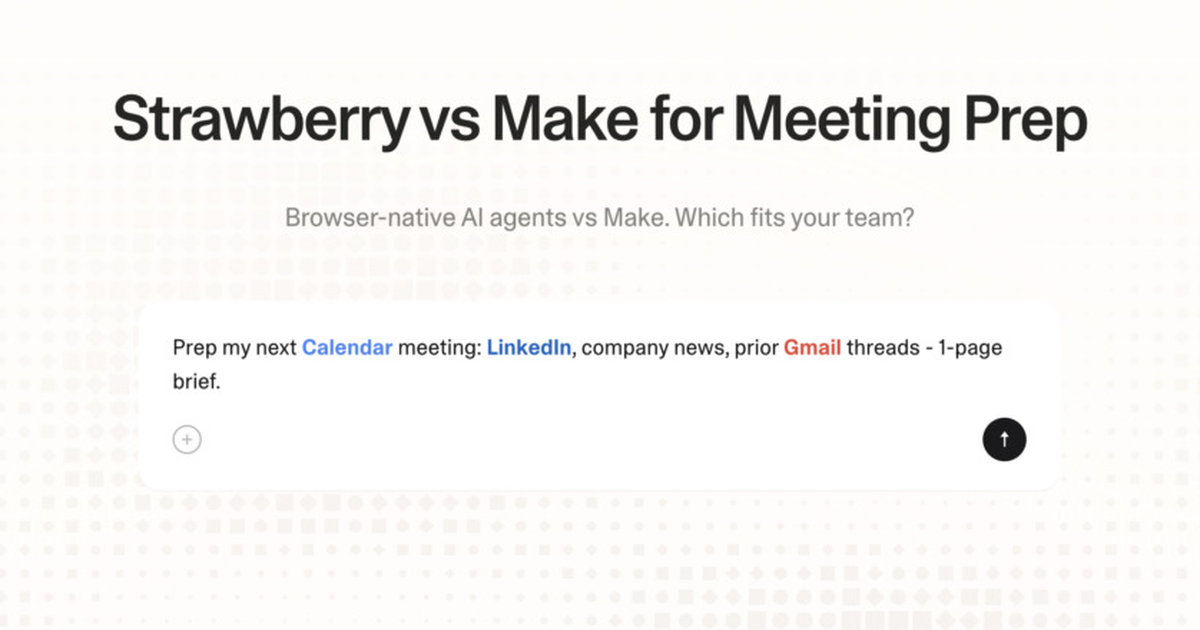
I have [tab/app] open. Help me prepare for a meeting for [name/company]. Read what's on screen plus any connected CRM and email context. Return: A 250-400 word brief: attendees, company snapshot, last touch, suggested agenda, 3 questions to ask. Anchor every claim to a real signal from attendee LinkedIn snapshots (role, tenure, mutuals) or company recent news (funding, hires, product). Do not invent facts. Stop before any external action - I'll review.
How Make handles meeting prep
Make's strength is visual scenario builder with branching, error handling, and 1500+ app modules. For meeting prep, that pays off when the inputs are already clean and the output is text - drafting messages, summarising notes, answering questions about pasted material. Where it slows down is exactly what meeting prep demands at scale: Make scenarios are static graphs. Teams using Make for this end up copy-pasting screenshots, re-typing CRM fields, and switching context every few minutes.
Honest tradeoffs
Pick Strawberry when the workflow has irregular inputs (different page structures, edge cases, judgment calls).
Pick Make when the workflow is a well-defined data pipeline with clean inputs and a fixed output schema.
Use them together when Make owns the drafting step and Strawberry owns the browser-side gathering and CRM write-back. Many teams keep both in their stack.
What a real meeting prep output looks like
Specific, not generic:
- Meeting: 14:00 Thursday with Anna Lindqvist (VP Marketing, Voi) and Erik Nilsson (Head of Growth)
- Last touch: warm intro from Marcus on May 14, no reply since
- Company news: Germany pullout announced May 28; hired 4 paid acquisition managers in Q1
- Suggested agenda: 1) Their take on Germany decision, 2) Where retention sits in 2026 priorities, 3) Show 90-sec demo of win-back loop
- Three questions: How is the team structured post-pullout? What's the budget cycle? Who owns retention KPIs?
Strawberry produces this by reading the relevant tabs and apps, then drafting. Make produces this only if the inputs are already pasted into the chat.
Pricing in context
Make: free tier; paid from $9/mo for individuals. Strawberry: free tier, Intern $20/mo, Part-Time $100/mo, Full-Time $250/mo, with team plans available. The honest comparison is hours of work saved per seat per week against list price, not list price alone. Teams that lean on meeting prep weekly usually hit payback in the first month on either tool.
Three mistakes to avoid in meeting prep
These bite regardless of which tool you pick:
- Generic bios instead of role-specific context
- Missing the most recent news that the prospect would expect you to know
- No link back to the prior conversation thread
Caveats
Strawberry holds back on sending email, updating CRM records, or changing shared systems until a human approves the action. Treat the agent as a fast first-draft author, not an autopilot.
Strawberry vs Make for meeting prep
Strawberry
Real browser + connected apps + judgment. Wins when the workflow has irregular inputs (different page structures, edge cases, judgment calls).
Make
Visual scenario builder with branching, error handling, and 1500+ app modules. Wins when the workflow is a well-defined data pipeline with clean inputs and a fixed output schema.
FAQ
Can I use Strawberry and Make together?
Yes - many teams do. Make handles drafting and Q&A on clean inputs; Strawberry handles the browser-side gathering and write-back into apps.
Which one is cheaper for meeting prep?
Per seat, Strawberry typically lands between Make's free and mid tiers. The right comparison is time saved per seat per week, not list price.
Will Strawberry send emails or update CRM without me?
No. Strawberry stops before external writes and asks for review. You stay in the loop on the irreversible step.
What's the biggest mistake to avoid in meeting prep?
Generic bios instead of role-specific context.