How Agency Owners Use AI Browsers for Partnership Research
How agency owners run partnership research in Strawberry using their existing tools and the browser. Prompt, real output, and tradeoffs.
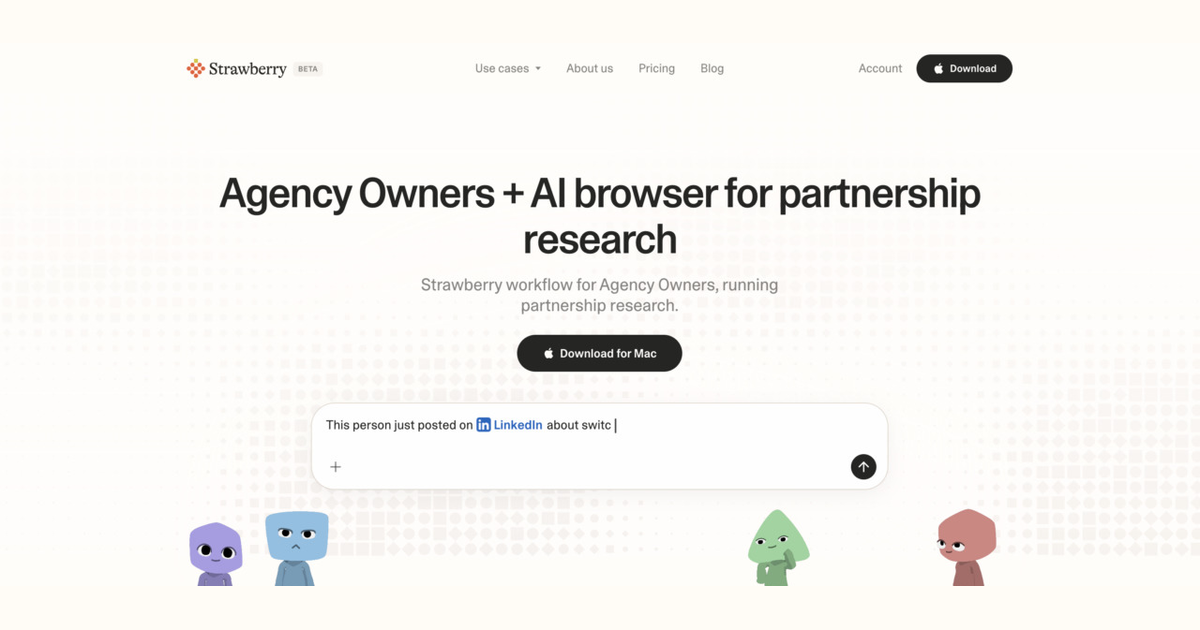
This guide is for agency owners who run partnership research. It explains how an AI browser like Strawberry runs the workflow given the tools a agency owner actually uses every day, what the output should look like, and where the workflow fits in the agency owner's week.
Why this matters for agency owners
A agency owner spends time on this: win new clients, retain existing ones, and produce billable work across multiple accounts with a small team. The pain that makes partnership research feel slow is real: client reporting and pitch decks consume the senior team's time; juniors cannot produce them at quality. The reason an AI browser helps is that agency owners already use multiple surfaces (Slack, Google Workspace, a CRM, HubSpot or Notion for client tracking, Looker Studio or sheets for reporting) to do this work, and the browser is the only tool that can read across all of them and produce a finished output.
What success looks like
The goal of partnership research is to decide if a partnership is worth pursuing and prepare a specific first conversation. For a agency owner, success metric is concrete: first meeting booked within 14 days, clear next step at the end of that meeting. A finished partnership research run should look like this: a draft client report, a pitch deck section, or a research brief that is 80 percent there and only needs minor polish.
Signals partnership research needs
The workflow needs these signals: audience overlap (do their customers look like yours); go-to-market motion (do they sell the way you'd want); history of co-marketing (do they ship with partners or not); current ecosystem partners (where do you fit relative to them). For a agency owner the practical question is which signals come from the tools already in the stack (Slack, Google Workspace, a CRM, HubSpot or Notion for client tracking, Looker Studio or sheets for reporting) versus what the browser has to fetch. Strawberry reads the in-stack tools through native integrations and uses the browser for the rest (LinkedIn, news, company websites, search). The agency owner stays in one surface.
Paste-ready Strawberry prompt
I'm a agency owner. Run partnership research for me using Slack, Google Workspace, a CRM and the browser, then save the draft.
What a finished partnership research output looks like
Concrete example, not a placeholder:
- Partner: Kime (GEO platform)
- Fit thesis: their users (in-house marketers tracking AI-search visibility) need an AI browser to run the research workflows that produce the content Kime tracks
- Audience overlap: 30-40% based on Kime's customer list (Saxo, Superb, THEMAGIC5)
- Shape: mutual referral, 15% rev share, 18-month attribution
- First ask: a 30-min product demo from each side, decide if MCP integration is worth building
When this works, and when it does not
This workflow is right for agency owners when the work is repeatable and crosses multiple tools. It is wrong when any output the agency cannot defend to the client without a human review pass. In that case, the agency owner should keep doing the work manually until the pattern is clear enough to automate.
Three mistakes to avoid
- Treating every integration as a partnership when it's just a checkbox
- No clear thesis so the first meeting is a generic 'let's see how we can help each other'
- Skipping audience overlap and pursuing partners whose users don't buy what you sell
Caveats
Strawberry holds back on sending email, updating CRM records, or changing shared systems until a human approves the action. Treat the agent as a fast first-draft author, not an autopilot.
How agency owners run partnership research with Strawberry
Tools
Agency Owners typical stack: Slack, Google Workspace, a CRM.
Browser
Public web, LinkedIn, news, search fill the gaps the stack does not store.
Compose
Synthesise into the partnership research shape that a agency owner can ship.
Human
Approve before any external action; save to system of record.
FAQ
Is this useful for a agency owner who already has a workflow?
Yes - the question is which part of the workflow is the bottleneck. If it is research, data transfer, or writing the first draft, that is where Strawberry helps. The agency owner keeps the judgement calls and final approvals.
What tools does the agency owner need to connect?
The most common stack for agency owners: Slack, Google Workspace, a CRM, HubSpot or Notion for client tracking, Looker Studio or sheets for reporting. The browser handles everything else (LinkedIn, news, search) without extra setup.
What is the biggest mistake to avoid?
Treating every integration as a partnership when it's just a checkbox.